Featured stories from around the world
Self Transcendence 24 Hour Race to incorporate English Chamionship
This year's Self Transcendence 24 Hour Track Race in London on October 8th & 9th will be the official AAA of England 24 Hour Championship race.
Official entry forms are now available online - to download the form click here. For more information about the race, please contact Run and Become on +44 (0) 207 222 1314.
For results and reports from last years race see our 2004 index.
Your Fitness: We will Rock You
Rock climbing is one of the fastest-growing sports in the UK â and the great thing is you don't have to trek off to the Lake District or the Cairngorms to do it. These days you can enjoy the experience indoors on man-made rock faces.

Thirty years ago, climbing was something most people knew about only through adventure magazines and television documentaries, but the burgeoning number of indoor centres with artificial rock walls in Britain means adults and children can now give it a try.
Until relatively recently, few people had done any real climbing because of their perception that long treks to remote spots were necessary before they could even get started.
Indoor facilities have since brought the sport out of the extreme and into the mainstream, and are attracting a wide range of climbers, from the experienced mountaineer who just needs a little practice for the real thing, to modern health club users looking for a more stimulating way to work out.
The boom in popularity has been put down to two reasons other than simply the need to exercise. First, climbing has been used successfully in recent years to add drama in advertising campaigns and films such as Sylvester Stallone's Cliffhanger. Second, the perhaps unique integration of physical and psychological challenge makes climbing an immensely satisfying experience.
Unlike the repetition inherent in many sports, and the boredom that some people suffer when taking part in conventional fitness training, every climbing experience offers something new. Moreover, technique and modern technology, as applied in most indoor climbing gyms, have virtually eliminated the element of danger. Apart from all that, it can be tremendous fun and is a great way to get your body in shape.

Rock climbing is a challenging, rewarding sport that appeals to people of all ages. Most indoor centres will cater for climbers of all abilities and offer classes with qualified instructors to teach safety and improve technique. Today's wide variety of climbing walls and methods allows beginners and advanced climbers to enjoy an indoor facility side by side.
It is often said that strength is no substitute for technique, but it can improve climbing ability. Still, you do not need to be super-strong, so youngsters and the more mature can enjoy the excitement of climbing and benefit from the added self-confidence they get when they make it to the top. Parents also get a terrific buzz seeing their children grow in assurance along with their accomplishments on the rock face. The sport has become so popular that some parents have organised their child 's birthday party around a climbing session.
Experts say women are especially attracted to the sport because it improves fitness, reduces stress and instils self- confidence. An added inducement is that climbing levels the playing field between men and women, because it does not depend on brute strength. The challenge is the same no matter who you are or how much upper-body strength you have. The sport can create a special bond between people who climb together because each has to depend so much on the other.
Top tips
It is a good idea to use duct tape to prevent blistered feet, but test it on a small area of skin first to be sure you do not have an allergy. To improve strength, weight training would be useful, and you should also include a balance-training aspect in your workout. While training, it is better not to overdo it, so try to avoid climbing on more than four days a week â just as with any other strength workouts.
If you travel further afield to try your hand at outdoor climbing, ensure that you study your proposed climbs in advance, and that your ability and experience are up to it. More importantly, never climb alone. Safety should always be your priority, so make sure that any facility you use is staffed with trained professionals using the best equipment. Seek assurances that safety precautions and methods of instruction are of an approved standard.
Fortunately, accidents are infrequent, but it is no use waiting until after you have been hurt to check out the climbing facility's insurance schedule. Make sure you are fully insured. It is also crucial to know the function of all your equipment before you start, so don't wait until you are halfway up the rock face to find out.
No experience necessary
You will find that most indoor climbing gyms are happy to take on total beginners. Even if you have never touched a rope in your life, they will teach you the skills needed to climb safely. They will also be able to hire all the equipment you need to have fun and get into shape. The basic gear needed for indoor climbing comprises a harness and a pair of climbing shoes, and these can usually be rented at most indoor centres. A belay device and a carabiner connector are also required, but you need only one pair between you and your climbing partner.
The Sri Chinmoy Marathon Team was formed in the fall of 1977 by members of the Sri Chinmoy Centre, who were students of the Indian meditation master, author, poet and philosopher Sri Chinmoy. The athletic looking teacher had been a champion decathlete, sprinter ,soccer player and volleyball coach at the spiritual community where he lived for 20 years. He had begun requesting his students to place more emphasis on their physical fitness as a means of enhancing and complimenting their practice of meditation. He felt that running was a perfect sport to enhance fitness and well being. Many had begun to practice athletics, particularly long distance running, walking, cycling and swimming. In 1976, 33 members of the Sri Chinmoy Centre organized and ran a continuous , non-stop relay through all 50 states, carrying a flaming torch and calling themselves the Liberty Torch Bicentennial Relay. Sri Chinmoy wished the runners to spread the message of dynamism and kindle the flames of love of country. They covered nearly 9000 miles of running, many runners averaging 100 miles a week in the process. Soon members of other countries conducted relays to show that spiritual people could also be dynamic, responsible members of their communities. We also entered 200 members in the 24 hour bike race in Central Park, garnering numerous awards and developing an appetite for training and racing.
As a service to the running community, the Marathon Team was formed to organize races of various distances. Sri Chinmoy felt that holding races for the public would give the running community joy and an avenue for friendly competition. He encouraged his students to train daily and compete often. On October 2, 1977, our first race of ten miles was held in Greenwich Ct. To make it special Sri Chinmoy had us offer split times every mile, have water and refreshment drinks every mile as well, and to provide enthusiastic support along the whole course. We even had singers line portions of the course and sing uplifting, encouraging songs about running and transcending.
A few weeks later about 60 members of the SCMT participated in the five borough New York City Marathon, starting a tradition that still flourishes today. Sri Chinmoy himself began long distance training, running every day and practicing for any and every local race. His enthusiasm was contagious. We began to search for courses in parks and on the streets of New York. We would even look for the hilliest stretches of road for important resistance training. A giant chart with everyone's weekly mileage was erected on the wall of our meeting hall and gym. Much inspiration was gained from seeing our daily and weekly totals in full view of everyone. Sri Chinmoy began to train for marathons and eventually ran 20 himself, with a best of 3:55:07 at the Heartwatchers Marathon near Toledo, Ohio, on March 25, 1979.
We also conducted a monthly lecture series featuring famous local and national runners, who gave talks about their running and encouraged us in our training. Some illustrious athletes included Ted Corbitt, Joe Kleinerman, Nina Cusick, Tom Fleming, Cahit Yeter, Craig Virgin, Bob Beamon, Calvin Smith and Carl Lewis.
In August of 1978 Sri Chinmoy suggested a 47 mile race in celebration of his birthday of 47 years. We hastily organized a 47 mile invitational race amongst the students, with help and advice from Ted Corbitt, the legendary runner and father of ultrarunning in the USA. Fifty-six out of 57 starters finished the race. Our interest in ultramarathons had been created. This particular race provided a springboard for excursions into longer and more demanding events. Talent began to emerge as well from our own group. Virendra Gauthier's time of five hours nine minutes still stands for the men, while Dipali Cunningham heads the women's standard in just over 6 hours, as well as having won the race 14 times for the ladies. Sri Chinmoy himself entered the race a few times and completed it in 1979 within the 13 hour limit with his inspiring determination.
As the number of competitors began to grow so did the number of races. 1979 saw our first marathon and half-marathon offered in Flushing Meadow Park, as well as shorter races and even triathlons. In 1980 we formed our first 24 hour race in Greenwich, Ct. In this race Marcy Schwam , the pioneer American runner, set three women's world track records for 50 miles, 100km, and 100 miles. The following year in the same race Cahit Yeter from New York set a North American 24 hour best of 155+ miles, and Sue Medaglia set a women's 24 hour world record of over 126 miles.
Branches of the Sri Chinmoy Marathon Team were formed in 20 other countries, and have expanded to nearly 100 around the world. Today, the Sri Chinmoy Triathlon in Austrailia is the National Long Course Championship, as well as the 100km road race. Our 24 hour races in Europe are highly respected, particularly in England, France, Germany, and Switzerland. In the 1993 24 hour event in Basel, Switzerland, some 120 runners from 15 countries took part, with the President of the International Association of Ultrarunners (IAU), Malcolm Campbell, calling it " the best 24 hour event ever staged".
The cornerstone of Sri Chinmoy's philosophy is the expression of self-transcendence- going beyond personal limits and reaching new levels of inner and outer perfection. This vision of the complete seeker-runner was also practiced by his students, many of them discovering talents they didn't know they possessed. Some began to train for marathons and ultramarathons, others began long distance swimming training.
As the enthusiasm for running began to grow, Sri Chinmoy felt that standard procedures for his races must be kept. We began to organize races on one-mile or two kilometer loops, using flat courses, so that runners could always expect a chance to do well. Water and refreshment drinks were to always be available, as well as accurate scoring and enthusiastic support. The number of our races began to grow, as weekly two mile events and sprints for children and seniors were offered. We also began to offer much longer races- 70 miles, 100 miles, 24 hours and 5 days.
I984 saw the appearance of the Greek legend Yiannis Kouros at the New York Road Runners Six Day Race, in which he set new standards for 48 hours, and broke the 100 year record for six days by running 635 miles. A few months later Yiannis came back to New York to run our 24 hour race, in which he established new road bests for 100 miles in 11hours 46 minutes, and smashed the 24 hour absolute best by 7 miles with 177 miles. A year later in the same race, but running in the teeth of high winds from Hurricane Gloria, Yiannis broke his own record with 178 miles. In the 1997 Adelaide Sri Chinmoy 24 hour Race, Yiannis Kouros set the new and probably unbreakable world record of 188+ miles( 305 km).
In 1985 we offered our first 1000 mile race in Flushing Meadow Park, the first of its kind in this hemishere in this century. Three runners actually completed the distance in the allowed timeframe. Leading the group was American distance pioneer Don Choi from San Francisco, California.
The Marathon Team also began holding monthly marathons at Flushing Meadow Park, hoping to inspire the runners to increase their capacity at the 26.2 mile distance. The Sri Chinmoy Marathon Team also developed a special and unique relationship with the New York Road Runners Club, the largest running club and organization in the U.S. We would often help them with the scoring of their National championship 100 mile race, as well as their 6 day affair at Randall's Island. We have often participated in the New York Marathon, having had over 350 SCMT runners the last several years, as well as offering support in its organization and providing aid stations along the course and clean-up in Central Park after the race. This service has been in place since 1978.
Sri Chinmoy took up weightlifting in 1985, slowly working his way up to eventual massive numbers of pounds with his special one arm lift, plus adding unusual lifts and feats of strength. His chronic knee injury prevented long distance running, but did not terminate his boundless energy for excelling at any sport. We had a special 200 mile race in honor of Sri Chinmoy's 200 lb one arm lift, in March of 1986, in which over 30 men and women ran 200 miles in his honor. In January of 1987 he eventually lifted 7,063 lbs in a miraculous one arm lift.
We began to offer track and field meets for athletes over age- 40, men and women, with our annual Sri Chinmoy Masters Games in 1985. Many former regional and national champions and some former Olympians including discus legend Al Oerter have taken part in the Games. Similar events are now held on the West Coast and in Europe. Sri Chinmoy himself still practices sprints and throwing events at age 69, as well as weightlifting, of which he is a record holder for a number of one -arm lifting and calf-raise events. In 1991 Sri Chinmoy surpassed his best times in this country for the 100 meters, 200m and 400m set in Puerto Rico in 1984. He feels faster times are still within reach.
In 1987 Sri Chinmoy increased his vision of the running world. He felt that a longer race of 1,300 miles would inspire a challenge for the ultramarathon runners. The Ultra Trio was born- a set of three ultra races of 700, 1,000 and 1,300 miles. World class distance specialists began to attempt the increasingly difficult mileages. This unique race still exists today.
That same year a new running adventure was born- the Sri Chinmoy Oneness -Home Peace Run, a relay run through 55 countries around the world, carrying a flaming torch for peace. The public was encouraged to participate, and local and national officials embraced the event. Over 250,000 people ran with the torch and took part in ceremonies that designated peace as a primary objective for world harmony- one person at a time, one step at a time. The Peace Run is now a biennial event, attracting millions of participants in over 70 countries. The U.S. event runs through all the 50 states, with thousands of runners joining in.
Sri Chinmoy's students began to excel in running and swimming as well. To this day 17 of his students have swum the English Channel, and several others hold or have held distance records for running in various countries, including the U.S., Germany, Switzerland, Canada, Hungary, and Japan. Others have recently taken up mountain climbing as a means of testing their limits.
The Marathon Team held national and world championship events in 1988 and 1989 at Flushing Meadow Park. The 1988 1,000 mile event was the I.A.U. (International Association of Ultrarunners) World Championship. Yiannis Kouros of Greece ran 1,000 miles in 10 days,10 hours, breaking the previous record by 1 1/2 days. Suprabha Beckjord of Washington D.C. won the women's 700 mile race in American Record time. Sandra Barwick of New Zealand set a new world standard for women at 1000 miles in 14 days,20 hours. In 1989 Rae Clark of California set a new U.S. standard for 100 miles and Ann Trason did the same for the ladies in the 24 hour event, besting the entire field for the National Championship, as well as setting a new world women's standard for 100 miles. Later that year Al Howie of Scotland became the first person to complete the 1,300 mile distance in a certified race (17 days 9 hours).
1989 saw the women's world best for 1000 miles claimed by Suprabha Beckjord as she broke Sandra Barwick's time by a mere 27 minutes. In 1991 Ann Trason broke the women's world best for 100 miles in 13 hours 47 minutes in our 100 mile road race. The 1991 Ultra Trio had a field of over 60 runners for all three races- unheard of considering the great distances being attemted. Al Howie came back to break his own record for 1,300 miles by 13 hours and Sandra Barwick became the first woman to run 1,300 miles in a certified race; enroute she smashed the 1,000 miles standard by two days! In 1992 Suprabha Beckjord returned to join the super elite group who have run 1,300 miles in a certified race, which currently totals eight men and five women. In the 1993 1,300 miler, Istvan Sipos of Hungary broke Al Howie"s record by nearly two hours. In 1994 Antana Locs of Canada won the 1300 miler overall, and was the first person to ever complete the 1300 three times. In 1995 Georgs Jermolajevs of Latvia broke the world mark for 1300 miles in 16 days 14 hours.
In 1996, the Marathon Team increased the Seven Day Race to 10 days. Latvian Georgs Jermolajevs won by a slim margin over Australian Dipali Cunningham, 725 miles to 723. A more astounding event took place in the summer of 1996. Six runners toed the line on a flat paved course around a park and a school in the neighborhoods of Jamaica, Queens, New York, only a few blocks from our Headquarters. The worlds' longest race of 2700 miles lasted 47 days, with a remarable five finishers out of six runners. Georgs Jermolajevs of Latvia again prevailed, setting new world marks for 3000km and 4000km as well as 2700 miles, in 40 days 11 hours. Suprabha Beckjord of Washington ,DC finished first for the women in 43 days, one hour.
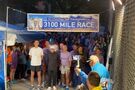
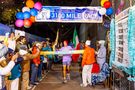
In 1997 Sri Chinmoy increased the world's longest certified race to 3,100 miles, hoping the runners would again transcend their capacities and inspire the running world . Edward Kelley of Huntington Beach,Ca. won the race in 47 days, 15 hours, even running an additional 7 miles to reach the magical 5000 km barrier. Suprabha Beckjord followed Kelley two days later to finish the 3100 miles as the first woman ever to run that great distance in a certified race. 1998 saw Istvan Sipos of Hungary smash the 3100 record in 46 days, 17 hours. Miss Beckjord repeated as women's champion with another sterling effort in 49 days, 14 hours. In 1999, in the heat of a record hot July, Edward Kelley won the 3100 mile race in 48 days, 12 hours. Suprabha Beckjord also completed the distance for the third time. 2000 had only four starters, but the youngest finisher in Asprihanal Aalto, a 29 year old Finn who dominated the race in 47 days, 14 hours.. Beckjord again finished, making it four in a row. Rimas Jakelaitis, a native of Lithuania, set a new 1300 mile world best time of 16 days+00:28:10 in another remarkable performance at Wards Island Park. In 2001, Dipali Cunningham from Australia returned to break the women's six-day road record with 510 miles. Ultra pioneer Ted Corbitt, 82, astounded the world by running 303 miles, an octegenarian record thst exceeded the previous record of his own by 63 miles. Rimas Jakelaitis set a new 10 day event best of 901 miles as the field for the two events swelled to 59 runners. A month later, Asprihanal Aalto repeated his 3100 mile victory in 48 days 10 hours. Suprabha Beckjord continued to amaze with her fifth finish in a row. In the last race of 2001, Paula Mairer rewrote the women's 1300 record with an astounding performance of 17 days,21 hours, breaking Sandra Barwick's ten year old record.
2002 was a banner year for the 3100 mile race. Madhupran Wolfgang Schwerk smashed the world best for 3100 miles with an epic performance of 42 days,13 hours., taking four days off the previous record. In the fall, Surasa Paula Mairer broke the 1000km and 700 mile world records at Flushing Meadows Park, reaching 700 miles in 8 days,15 hours. Martina Hausmann of Germany won the 1300 mile race in 18 days,23 hours.
2003 saw Hubert Muckenhumer dominate the Ten Day with 631 miles. Paula Mairer dominated the 1000 mile race in 14 days 12 hours, winning the race overall. Namitabha Arsic won the 3100 miler in 49 days 2 hours. In 2004, Ashprihanal Aalto dominated the 3100 with a 46 day, 6 hour victory, the second fastest alltime. Rimas Jakelaitis won the Ten Day for the fourth time with 653 miles. Dipali Cunningham won the Six Day overall with a new age-group(45-49) world best of 479 miles. Dipali came back to win the 700 miler in the fall in 9 days 21 hours. Last year, Danny Ripka from Naples ,Florida won the Six Day with 478 miles, ahead of women's eight-time winner Dipali Cunningham's 474 miles. Srdjan Stojanovich became the fastest first time winner of the 3100 miler, and third fastest alltime in 46 days 10 hours. Suprabha beckjord finished the 3100 for the ninth time, a truly remarkable achievement.
The horizons of the running world are still expanding according to the remarkable vision of Sri Chinmoy: Run and Become. Run to succeed in the outer world. Become to proceed in the inner world. As we attempt to manifest Sri Chinmoy"s dream for the continuous progress of mankind in all endeavors, we offer our best wishes to all the seeker- runners who share a dream of going where few have ever gone. The challenge and the joy of transcending is the greatest gift and the best opportunity at true satisfaction in human life. Our oneness with their efforts is our true joy.
Sri Chinmoy Marathon Team
"something within me kept me going"
I have always considered that a marathon is like life. The experiences we go through while running a marathon reflect what we encounter in life; its up and downs and the fact that at the beginning we can never tell what the end is going to be like. As in life, we need lots and lots of help from everything, not only outer but also inner and we need our entire being to work at the challenge
In life it is advantageous to have someone who you can look to for guidance, protection and inspiration. So what about the marathon? The Self Transcendence Marathon on 25th August 2004 was my third marathon. During it I could really feel guidance, protection and immense inspiration from everything. From nature's beauty, people's support and the very presence of Sri Chinmoy, which surcharged the whole course with light and energy.
My training for the marathon this year was pretty poor. In June, I could not run a mile without stopping! So being rather desperate, I adopted Ongkar's suggestion to run for 2 minutes and walk for 1 minute during training, and then follow that practise in the marathon itself. If the ratio of 2 to 1 became too easy then up it to 3 to 1. So I did three long runs of 3min. run and 1min. walk prior to the marathon.
On the day of the marathon, I had planned to run 4min. and walk 1min. When the day arrived, quite frankly, I wasn't sure whether I could run a marathon, it all seemed unreal. But something within me kept me going. It was not just a case of my body going through a long and difficult ordeal, my heart was running the entire race too and my vital and mind was clam and focused. Whenever I got into difficulty, I chanted 'Supreme' and the result was remarkable.
I did a P.B. of 4.51 and with the walking breaks, I felt pretty strong throughout the entire race, I could feel a constantly recharging inspiration, vibrant light and energy from all corners of the course. I am grateful for this experience. It was a heart victory and I offer the experience and result at the Feet of Our Lord Supreme.
If we approach life with our focused and harmonised self, everything is possible. Such as running a marathon!
Hemabha Jang
London
"Normally I do not like marathons."
Whether I train or do not train, whether I run fast or slow, I always have the experience of hitting the wall. All your energy disappears, and then very soon afterwards all your inspiration disappears too. You stop thinking about running a good time you just want to finish and you don't care how slowly you do it.
Which is a shame because I enjoying running short distances I feel I can give everything I am doing my best. Not so for a marathon. I always feel that I have underachieved, even if I finish totally exhausted.
This marathon was different. This time I tried technique a new technique I heard of from the staff at Run & Become in Cardiff. The idea is that you walk for 45 seconds after each mile and it is important that you start right from the first mile. This gives your
running muscles time to relax and means that you can run longer even on little training. As I had done very little training I thought I would try this technique.
I was amazed. In training my longest run had been 14 miles. I was very tired at the end of that. However, using this technique I did not feel really tired until mile 24. Each mile, from about mile 7, I was expecting to totally crash but to my immense surprise and joy it never happened. Even at mile 24 it was not so bad I just had to walk a little more, that's all.
I was expecting to run one of my slowest times, but in fact I ran my fastest ever time 3:52.
At the end of the marathon I felt triumphantly happy and also very grateful for my new marathon experience. Now, for the first time, I am actually looking forward to my next marathon!
'What's going on?' said a bemused resident, out walking his dog on the afternoon of 9th October.
'What they're running like this for 24 hours? Well I'll come back tomorrow morning and cheer 'em on.' And off he went across the common with spaniel in tow. We never did see him next morning.
When you try to describe the 24 hour event I usually suggest that one comes along and experiences it. Not by running it, although that's an excellent way to experience it, but by just joining in the many activities like helping the runners, lap scoring, assisting with the refreshments, keeping the scoreboard up to date etc. For those who come and partake, very quickly realise that the world of ultra-marathons is really quite special and very enjoyable.
Such was the case at Tooting Bec this year when 30 runners moved off at noon on Saturday and finally stopped at noon on Sunday. As race director I had to be sure that everything was covered to enable the runners to do their best. The weeks before the race are often more hectic for me than the race itself. Making sure that everything is in place ~ sufficient lap counters, physios, timekeepers, refreshment providers, a counting shed etc. Judging from the comments and letters we have received from the runners after the race the race was clearly successful. All the helpers said how great the experience was.
So what's next? Well next year the race has been recommended as the National Championship for 24 hours and also as a trial for the selection of the 24 hour Bristol Team for the World 24 Hour Championships in 2006.
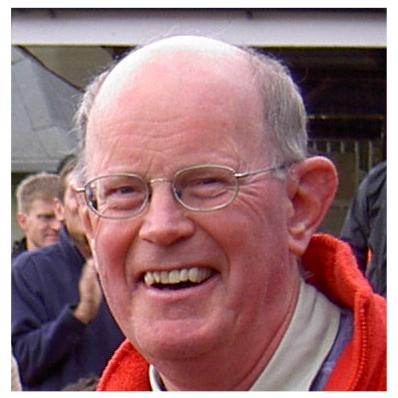
Provisionally the race is set for 8/9th October 2005 and hopefully at Tooting Bec.
Ongkar Smith
Race Director U.K.
It was a beautiful day, fairly clear and cold. There were big grey clouds in the sky as we drove towards Halifax, but above the race area the sky was blue. We left nice and early, but in the end it was touch and go whether we would make it because we got stuck behind a tractor.
Make it we did however, and mid-day saw us lined up at the start with our numbers pinned on, and plenty of nerves all round as for 3 of the 4 of us this was our first fell race.
The terrain was mostly not too rough underfoot , but the ascents certainly were steep. Heavy rainfall the day before made the downhills especially nice and slidy!
The course is very well marked with plenty of marshalls who were all unfailingly encouraging and enthusiastic. The last one tried to comfort me with the news that the steep slope ahead was the last uphill before the finish but I was too zoned out by that point to understand what she said, so I was somewhat surprised to turn a corner at the top and see the finish ahead of me. I'd been convinced that there must be about another mile to go! I really must get into the habit of looking at the course route beforehand!
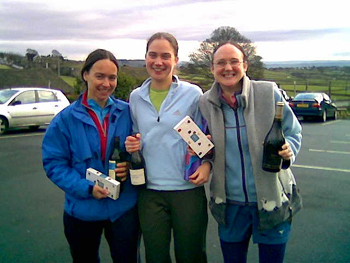
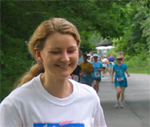
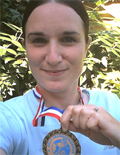
Prizegiving was in the pub at the end of the lane, with chip butties to keep us going until all the results were in. It turned out to be a good day for the Sri Chinmoy AC women's team - Amelia was second lady, Bhauliya was first lady V40, Nurari got a spot prize, plus we won the lady's team prize. Here is a photo of the girls with their haul (I am behind the camera).
Aside from the prizes, one of the best features of the race was the friendliness of the locals. We'd all enjoyed it and said we'd try and come back next year. "Why not next week?" was the reply.
Kokila

In the summer of 2004 the Sri Chinmoy Marathon team held a global gathering in New York. On August 25th we staged our third "Self Transcendence Marathon" in Rockland State Park.

Sri Chinmoy started the race at 7am then almost a thousand runners set off on the epic 26.2 mile journey. Among them were many members of the Sri Chinmoy AC from the UK - here are their finishing times, pictures and race stories. Congratulations to Dhavala Stott of Edinburgh for winning the women's race in a time of 3:10:57 and for being the fastest British entrant, beating all the men by some distance!
Click on a runner's name to read their account of the race.
![]() |
Dhavala Stott 3:10:57 |
![]() |
Roger Chamberlain 3:19:44 |
![]() |
Stephen Guy 3:32:47 |
![]() |
Shyamala Stott 3:40:44 |
![]() |
Suswara Payne 3:52:42 |
![]() |
Agnes Molnar 4:12:13 |
![]() |
Ramita Kvirencova 4:18:27 |
|
Devashishu Torpy 4:28:03 |
|
Bhauliya Moss 4:30:17 |
|
Mariya Latinova 4:36:46 |
|
Adarsha Kelly 4:40:05 |
|
Indrani Mehta 4:50:36 |
![]() |
Harashita Wardrop 4:50:54 |
![]() |
Hemabha Jang 4:51:43 |
|
Sahana Gero 4:58:54 |
|
Nurari Merry 5:00:00 |
![]() |
Fran Chamberlain 5:14:46 |
![]() |
Janaka Spence 5:15:24 |
![]() |
Piyasi Morris 5:28:27 |
|
Karteek Clarke 5:29:42 |
|
Dipika Smith 5:33:09 |
|
Bhashini Neve 5:39:59 |
|
Tirthika Gero 5:45:14 |
![]() |
Sladjana Vracar 5:50:16 |
|
|
Alena Pelantova 5:53:54 |
![]() |
Tsveta Gagova 6:04:03 |
|
Shankara Smith 6:09:00 |
| Ongkar Smith 6:09:51 |
|
|
Diane Channing 6:37:45 |
|
Bandana Spettigue 6:43:37 |
|
|
Janani Spence 6:44:27 |
![]() |
Arpita Stott 6:50:20 |
|
Sumangali Morhall 6:53:25 |
|
|||||||
|
|
|
"Transcendence of the body, the vital and the mind is what our goal is; to take the challenge of going beyond our limitations."
My first marathon in N.Y. started with a dilemma. The day before the marathon I felt sick. I was feeling dizzy and my mind wasn't working! I rested and said to myself: 'Just wake up and see how you feel.' I decided to do it; to at least try, to start. But what really made me do it was that I had given an inner promise. The other thing that gave me strength was the meditation before the start.
I started slowly. I was able to run for about 10Km with short breaks. After that I started walking most of the time and running for a few minutes. I got pain in the left hip and my hand was aching, so I had to be patient, I kept saying, 'Don't think about it, just keep moving.' I was thinking I would finish in 7 hours, but I knew I was doing my best. I was walking/running with people I wouldn't imagine being able to run a marathon, but they were doing it, because of their love, because we believe in the self-transcendence. Transcendence of the body, the vital and the mind is what our goal is; to take the challenge of going beyond our limitations. All these people gave me so much inspiration, so much happiness ~ they were trying to do it. Some were having fun, joking and laughing for hours. And there was Sri Chinmoy staying with the runners for nearly 7 hours, smiling and smiling.
Eventually I crossed the finish, sooner than I expected. I remember I couldn't speak, I just wanted to lie down.
I hope to do it better next year. A bit more training will help, I think! So, to the next marathon.
Many thanks to the helpers at the water stations. They were so enthusiastic, so encouraging.
Tsveta Gagova
PlovdivHave you ever wondered how participants prepare for a 24-hour race or cope with the challenge? Or maybe you're considering ultra racing yourself but are not sure where to start? Well read on. In this feature, Paula Bartimeus gets the inside story from the winners of the 2004 Self Transcendence 24-Hour Track Race.
Ken Fancett
From Kent
Age 55
Placement: 1st overall
Distance: 133 miles 801 yards / 214.775 km
When did you first start running?
I've been running for about 12 years. I actually come from a hiking background from where I progressed to non-competitive walking challenges. At some stage on these trail events I began to combine walking with running, until eventually I used to run most of the way. Then I got into road racing, my first road race being a marathon. So I guess I done things the opposite way round to most runners- starting with longer distances first and later participating in middle distance events.
How many 24-hour events have you participated in?
This was my second 24-hour race, having achieved 114 miles at Doncaster in 2001.
What other ultras have you done?
I have done about eight 100-mile events with the Long Distance Walkers Association. Although these types of challenges are non-competitive (prizes are not awarded), I was told I came 5th out of about 400 participants at the Exmoor 100 event earlier this year.
What inspired you to take up ultra running?
I was naturally drawn to long distance walking and found that it was something I was good at. As I started later in life, at about 40, I haven't got a big running history like other runners, but I'm an endurance type of person rather than a speed-orientated one, so ultra races are ideal for me. When I run ultras I don't have to worry too much about speed, I can concentrate on running at a comfortable pace.
What kind of training schedule do you follow before a race?
I don't follow a training schedule as such but I participate in lots of events; in fact I do a race most weekends. I generally run about three to four times a week but my mileage depends on what races I happen to be running in that particular week. So far this year (up until 25th October) I've completed 40 running challenge events.
What advice would you give to a novice in ultra running?
I would suggest that novices try walking a few long distance events first so they get a feel for them. As many runners I speak to are put off running ultras due to psychological barriers, by walking them first it can help overcome the initial block or fear.
Do you eat a particular type of diet when training and do you take any nutritional supplements?
I eat a simple diet and although I'm not strictly a vegetarian I only eat meat about once every two weeks. I prefer carbohydrate-type foods like pasta and potatoes, with plenty of vegetables. I don't take any nutritional supplements as I'm a firm believer that we can get everything that the body needs from food.
How did you sustain yourself nutritionally during the race?
I nibbled some cake every hour and made sure I got enough fluids including water, some kind of energy drink that was on the trackside drinks table (although I'm not sure what it was), tea and hot chocolate. I also ate the supper (vegetable crumble) and breakfast (porridge, egg and toast) that was served.
In this particular event, what was your highest point and did you have any low periods?
My highest point was winning the race, as this is the first event that I've officially won first place. After running continually for 22 hours I realised from the scoreboard that I was 11 miles ahead of the next runner so I relaxed and race walked for the remaining two hours.
I also had high points at the eight-hour mark when I saw I had completed 50 miles, at the 12-hour mark when I had completed 72 miles and at the 17-hour mark when I had run 100 miles. Generally, there were no low periods and I had no major problems.
How many pairs of running shoes did you wear during the race?
I brought along a spare pair of shoes just in case, as I was wearing in a brand new pair for maximum cushioning. But they were fine, so I didn't need to change.
How do you occupy your mind on a track for 24 hours?
I'm a bit of a daydreamer anyway, so much of the time I was enjoying myself in a world of my own. Saying that, after I'd run 50 miles I was frequently trying to calculate the finish distance, so there was quite a bit of mathematics going on in the brain.
How long did it take for your body to recover?
I had three days rest after the race and then went for a slow run on the fourth and fifth days. As we speak (almost three weeks after the event) I still haven't fully recovered but then that was my own fault. Last weekend I ran a marathon on the Saturday and a half marathon on the Sunday even though I knew I should have given myself more time to recover. But like many runners, I'm an addict.
Do you feel ultra running has changed you as a person?
I don't know if running has changed me but it's a very important part of my life and one that I wouldn't want to be without.
Jill Green
From the Isle of Wight
Aged 63
Placement: 1st in the women's category, 6th overall
Distance: 105 miles-327 yards / 169.28 km
When did you first start running?
I'm not actually a runner; I'm a race walker. Although I came from a family of walkers, it wasn't until 1977 that I started to take walking seriously. I joined the Long Distance Walkers Association and found that I was actually rather good at covering long distances. Then in 1991 I was chosen to represent Great Britain in a 28-hour race walking challenge in Roubaix, France. That was my first official competition and I came third in my category.
How many 24-hour events have you participated in?
I only record 24-hour events that I make 100 miles or more in. So far, I've completed 55 events in excess of this mileage, including the Paris to Colmar (200+ miles) three times. I've also become a Centurion (someone who has walked in competition 100 miles within 24 hours) in six different countries: England, Holland, USA, Australia, New Zealand and Malaysia.
What inspired you to participate in ultra events?
At first it was because long distance walking was something I was good at and which I enjoyed. As I became more experienced I set myself a goal of becoming a Centurion in the six countries that hold Centurion race walking events. I have now achieved this challenge.
What kind of training schedule do you follow before a race?
I don't have a set weekly routine but I walk about 3,000 miles a year. At 63 I'm careful not to over-train, but at the same time I put in enough hours to remain fit and strong. I live in the Isle of Wight and there's nothing more beautiful that seeing the sun rise over the sea when I'm out on one of my early morning sessions. I also make sure I stretch before and after training; I've been very fortunate to remain virtually injury-free.
What advice would you give to a novice in race walking?
Train regularly and build up distance gradually. Also, get advice on technique from experienced race walkers and join a local race walking club.
Do you eat a particular type of diet when training and do you take any nutritional supplements?
I've been vegetarian for about 30 years and this diet suits me perfectly. As for supplements, I take spirulina because it's a natural product and contains an all-round, balanced nutritional content.
How did you sustain yourself nutritionally during the race?
The food was wonderful and because it was all vegetarian I knew I could eat whatever was available: sandwiches, fruit and some delicious soup, plus the veggie sausages at breakfast.
In this particular event, what was your highest point and did you have any low periods?
Earlier in the year I missed out on achieving a 100-mile goal in 24 hours by just half a mile, so covering 105 miles this time round was a real confidence-booster. And coming first in the women's category was the icing on the cake- especially as it was my birthday on the second half of the event. In fact, I enjoyed the race so much that there were no low points for me.
How many pairs of shoes did you wear during the race?
Only the one pair. When the race had finished and I went to take a shower I noticed that I had a large, painful blister on my left foot. Oddly enough, I had no pain while walking, which was fortunate.
How do you occupy your mind on a track for 24 hours?
Although it may look mundane, it's anything but boring. First of all I have to concentrate on timing and keeping my speed just right so that I can remain on target for my planned mileage. Eating and drinking regularly is also a preoccupation- and one which at this event was most enjoyable because the food was so good.
The camaraderie on these types of events is fantastic and I often get chatting to a number of participants. Then there are times when I go into a trance-like state and walking becomes a meditation. Having my Walkman also helps.
How long did it take for your body to recover?
The race finished at 12 noon on Sunday and I went straight home and got an early night. By Tuesday I was already taking part in a challenge called the Viking Way, which is Lincolnshire's long distance footpath (147 miles) from Barton-on-Humber to Oakham. I know it sounds as if I'm a glutton for punishment but the event was spread over a course of a week and the countryside was beautiful. I have to admit though; I did feel a little tired.
Do you feel ultra walking has changed you as a person?
I generally feel that participating in a sport of any kind is a great stress-reducer and life-enhancer. As for race walking, it has provided me with endless opportunities to be out in the elements and in the part of the world I come from- the Isle of Wight- nature is sometimes breathtaking. I'm sure this has enriched my life no end.
"This marathon was one of my worst times, yet one of my happiest marathons."
I completed the Sri Chinmoy Self-Transcendence Marathon in 4hrs 50 mins. Not a brilliant time, but since injuring my back a few years ago I am always happy to be running âany' time, anywhere. Several friends had run the marathon previously and extolled its virtues. I was eager to embark on another marathon, so I decided this was the one- it would test the strength of my back, and my mental resolve.
Redundancy and a complete career change for me in April resulted in lack of training and an appalling weekly mileage, averaging 8 miles even well into June (and the marathon was in August). As a âwell-seasoned' runner I knew it was fool-hardy to embark on a long-distance run without sufficient training. So what was I going to run on- Faith? Well, yes, I intended to use some of that. But I was also hoping to find something, well, more in the way of a âmagic-word' I could chant that would turn me into an Olympian overnight.
Predictably, that didn't happen, but I found inspiration from Sri Chinmoy's books that helped me prior to and at every step of the marathon. Firstly, to maintain energy throughout, Sri Chinmoy advocates entering each task we perform with"happiness and enthusiasm". I tried to maintain that positive attitude. I also used two valuable visualisation techniques. Whilst at work:
âIf your conscious mind makes you feel that you are taking exercise for your participation in athletics when you go up and down the stairs, then automatically all your muscles will get enormous strength." (Aspiration-Glow and Dedication-Flow, Part 2)
âWhen you feel that you are tired, exhausted, please breathe in quietly. Take several deep breaths and try to feel that you are breathing in from various places- through the eyes, the ears, the forehead, the shoulders, and so on. Then energy enters through the various doors into your body. (Aspiration-Glow and Dedication-Flow, Part 1)
The marathon itself lived up to expectations. I found it a joyful experience. It was very well organised, with refreshments and encouragement all along the way. One chap stood for hours by the roadside reading aphorisms aloud, which served as constant encouragement and reminded me of why I love to run.
This marathon was one of my worst times, yet one of my happiest marathons. How is that possible? As a seeker-runner on a spiritual path Sri Chinmoy sums it up like this:
âThe seeker who recognises his inner oneness with the rest of the world will not feel sad and miserable if he does poorly. Only he will say,"I did what I could during my practice , and now the result I am taking as an experience..This kind of experience- both success and failure - is absolutely necessary for everybody in every walk of life." (The Outer Running and the Inner Running.)
Indrani
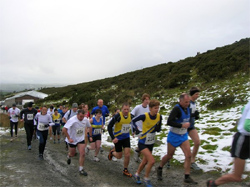
(with quotes from Sri Chinmoy)This was my first multi-terrain/ hill race and I felt a mixture of excitement and apprehension as we neared its remote starting point in the car. Snow lay on the surrounding hills and a watery sun shone through hifh cloud. On the ground, melting snow and sticky mud caught out more than one vehicle as they attempted to park on the steep hillside off the road. The sound of revving engines and voices rose into the cold midday air in an otherwise still and quiet rural landscape. I had travelled down from London to run as part of the Sri Chinmoy AC team with Roger from Cardiff, who would also be running, and Ed from Bristol who would be cycling.
We gathered with the other runners shortly after the finish of the junior race. The race director's breath hung in clouds as he addressed us in a lilting Welsh accent. Most of his words were carried waway on the breeze to the hills before we had a chance to hear them, until the word 'go', loud and clear, generated a burst of friendly jostling and animated chatter as we started off up the first hill.

We gathered with the other runners shortly after the finish of the junior race. The race director's breath hung in clouds as he addressed us in a lilting Welsh accent. Most of his words were carried waway on the breeze to the hills before we had a chance to hear them, until the word 'go', loud and clear, generated a burst of friendly jostling and animated chatter as we started off up the first hill. The ground was wet and stoney to begin with, but gave way to deep mud and splashy puddles as we turned a corner following a farm track into the fields.
Snowy hills unfurled invitingly before us and I wondered where our destination, the mast of the race title, could be. My attentions was soon consumed by mu feet, howerver, as the path headed steeply downhill. The mud was thick and slippery from recent snowmelt and hid loose stones and rocks. In high spirits, we charged down the track into woodland and splashed through a stream at the bottom. From there the gorund sloped up hrough tussocky fields and out onto a road. The gradient continued and I began to struggle somewhat, especially when I waw where the road was leading - to a steep exposed hillside and the bright grey sky above. Once there, the hill reduced me (and many other runners!) to a walk, hands on thighs. We were rewarded a the top vy a panorama of low, snowy hills and distant rain-fraying clouds. The going eased for a while before climbing steeply afain to the mast that marked the 'mearly halfway' point. Skirting the mast my legs felt tired and unwilling, but the sight of a lonf descent cherred me. i passed a cyclist heaving his bike over a stile and he soon overtook me on the descent as gravity pulled us faster and faster over the ground that blurred beneath our feet. I caught hasty glances at the rolling, snow-covered landscape below us to the right as my descent became less controlled and my eyes watered. We turned a corner into a farmyard where the owners had put up balloons and a colourful sign to welcome us (the race, I presumed) to the farm. I had barely a moment to read it and register surprise at the bright, artificial colours after focussing for so long on snowy grass and the mud under my feet. The continuing gradient pulled us on past some bystanders taking photos of the runners, through an extremely boggy field and over a (by this time) welcome stretch of road. A light misty rain fell but with no noticeable wind it did not feel cold. Soon we were passing the 5 mile marker and reached the final hill, the same we had descended near the start. I struggled cheerfully up the familiar route, through stream and mud as fast as my legs would go. Try as I might, I did not seem to be making much headway, but the runners in front of me did seem to be getting closer so I pushed on. Up the final tarmac path to the finish line I was elated to still be in one piece!

pic: Amelia just after crossing the line (photo by Balavan)
Roger had finished in 10th place in 47.55 and Ed had finished second cyclist in a time of 51.18. We managed second team place overall and were generally pleased with our results! Roger had knocked 5 seconds off his previous best on the course, Ed had written well on a testing course for bikes and I was just very happy to have finished, not last, in just under an hour. Whilst the uphills had been punishing, they had brought with them the delights of a few seconds of magical, fleeting beauty at the top and the sheer joy of hurtling back down as fast as you could go. I enjoyed it immensely as had almost everyone else I saw or spoke to.
An atmosphere of relaxed satisfaction filled the gnetly buzzing prize-giveing ceremony. Happily, we ate mars bars and talked and drank steaming hot tea. My lungs felt stretched and clean from breathing the cold, wintry air outside. The race winners collected their prizes and we ambled back to the car as it all drew to a close. A few cars had to be shoved out of the mud on their way out of the field and the sun dipped lower behind darkening woods as we made our way home, sore but happy!
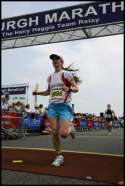
A group of us from Run and Become had been working hard at the Marathon Expo, and we opted to run the relay rather than attempt the full 26.2! Our aim was just to beat Dhavala's solo effort in London of 3.14, which we did, by around ten minutes. The Edinburgh Marathon site has a few thumbnail pics of us so here they are (full versions will be less fuzzy but you have to pay for them:)


Amelia ran the anchor leg of the marathon- on finishing she was presented with not one but 5 medals but she graciously agreed to share these with the rest of the team.
Overall the Sri Chinmoy AC team came 18th out of over a hundred entries and also set a new club record for the event by beating Hyamallar's all-boy team, but we have agreed not to mention that in this report.
Our total time was 3:06 and we placed 18th in the team relay (though some confusion at the start means there is a question mark over those results - I'm sure not all the teams started at the same time!)
The legs were:
ROGER Princes' St. - Victoria Pk - 7.7 miles 50:46
BHAULIYA Victoria Pk - Marine Dv, Silverknowes - 4.2 miles 32:58
SHYAMALA Marine Dv, Silverknowes - Ocean Terminal - 5.6 miles ??:??
DHAVALA Ocean Terminal - Portobello Beach, Kings Rd - 3.5 miles ??:??
AMELIA Portobello Beach, Kings Rd - Holyrood Park 5.2 miles ??:??
Results online at Edinburgh Marathon Site
http://www.edinburgh-marathon.com/
"After a long and gruelling 5 ½ hours I hobbled up the grassy bank to the finish line."
Two basic problems were apparent before I started this race. Firstly, I had done no training as I had spent most of the previous 6 months either in swimming pools, lakes or bits of ocean training for my English Channel swim. Secondly, there was a serious problem with my right knee.
After a long and gruelling 5 ½ hours I hobbled up the grassy bank to the finish line. Most people had already finished, been swimming in the local pool, showered and had lunch.
My only consolation came a few days later when Ashrita told me he had done a marathon in 5 hours 45 minutes. His best friend had jokingly told him not to eat for three days. He took it seriously and started the marathon feeling rather depleted.
Next year I shall either improve or devise such an excuse.
Karteek Clarke, Edinburgh
- ‹ previous
- 15 of 21
- next ›